The following is a short documentary and feature story. Supported through the Steve Steinberg Reporting Award, I am currently expanding it into a long-form video, audio, and written narrative about veteran nightsurfers who use sensory deprivation and high-adrenaline conditions to manage PTSD. As governmental resources shift, understanding the role of peer-led “mission therapy” groups and solutions outside traditional treatment models has become increasingly important.
Surfing Saves Lives: Veteran Surf Alliance Offers Community, Healing for Veterans
A white trailer covered with stickers sits parked on the boardwalk of Capitola Beach. At the very top of its back door is a small American flag sticker with alternating white and blue wavy stripes. It reads, “We are the United States and Oceans of America, the land and oceans of the free and the waves of the brave.” A much larger “PATRIOT” sticker in the shape of a shield sits directly under it, and below that, a line that states, “SURFING SAVES LIVES.”
Many of the stickers are the same, a round logo reading “Veteran Surf Alliance.” A few yards down the coast, dozens of men and women wear T-shirts with the logo printed large on the back. Those in black are surf coaches, and those in white, learners.
The Veteran Surf Alliance (VSA) is a Santa Cruz-based nonprofit dedicated to building community among veterans and easing the transition from military service to civilian living through surfing. In 2017, Army veteran and VSA Director Sean Meyer founded the group after surfing helped him cope with his new life after service.
“I grew up in a broken home, really, and grew up always wanting to be a part of something larger,” Meyer said. “I always knew that, you know, when I was younger, I needed that direction and really needed to learn how to be a man.”
A couple years after high school, Meyer joined the Army as a combat engineer. After spending years clearing roadside bombs in Afghanistan, he became a combat medic and ended up in Fort Bragg, North Carolina on their forward surgical team.
“Dealing with a lot of different types of trauma on different levels, that led me towards getting out, starting a family and having a hard time with the transition,” he said. “The transition was a very, very difficult time. Learning how to be, uh, not a soldier—learning who I was. I had to really rediscover myself. So that’s how the VSA was formed, through that journey, really.”
Meyer in the hospital when Veterans Affairs psychiatrist, Dr. John Straznickas, asked him a question: “Do you want to go surfing?”
Meyer said yes, and he was soon off to learn how to surf through Operation Surf, an organization that offers weeklong surf therapy programs to veterans. He vividly remembers his first time on the waves as transformative.
“I was hooked,” he said. “The first time smiling in forever and laughing… The understanding that these walls can be broken down, and there is light. There’s an opportunity to heal. And so I felt this need to share it, because it was shared with me.”
The experience inspired him to make surfing a regular part of his life. “Very organically,” as he describes it, Meyer, some fellow veterans and Straznickas began meeting every Tuesday at Linda Mar Beach in Pacifica to surf. It became a ritual, a way to connect with each other and the ocean, to find peace and healing in the waves.
“Every Tuesday, we were going to meet,” he said. “No matter what was going on—what kind of anxieties we had, and just whatever crud was going on in our life. We were going to show up for each other.”
Two years later in 2019, the group reached 501(c) status. As of 2024, it has grown to over 350 members.
“I got a, uh, ‘How to Start a Nonprofit for Dummies’ book, so it’s been doing good so far,” Meyer said, laughing. “It’s reshaped this life I have now.”
Varied Experiences, Shared Flow
On October 26, 2024 at Capitola Beach, the VSA hosted their annual Halloween Surf. Meyer took out first-timers on the water while wearing a french fries costume. On the boardwalk, his wife Tiffany Meyer, dressed as a burger, spoke to Army veteran Charmaine Bueno DeVivo while overlooking the coast.
“It started with something so simple for my husband, right?” Tiffany said. “He just wanted community himself. He wanted support, you know?”
Bueno DeVivo responded by speaking to the importance of veterans finding that space where they can feel safe and connected. Her experiences surfing and hiking have provided her with moments to think back on when in stressful situations.
“When I go and I’m around in a civilian world, I can navigate,” she said. “I can use, like, kind of a ‘stop’ method and go back and go, ‘OK, I’m OK… I can manage through this.’”
Bueno DeVivo served in the Army in the late 1990s and early 2000s as a mechanic. She was stationed in South Korea, where her unit of roughly 230 people included only 15 to 20 women.
“[Military gender disparity] is already dominant in the U.S., but traveling makes it even more intense,” she said.
Bueno DeVivo experienced military sexual trauma (MST), which affects one in three military women, according to the VA. The trauma from her service led her to develop PTSD, leaving her feeling disconnected from others and angry toward the military.
“I spent a lot of years hating the military,” she said. “In some ways, it was like a love-hate. I was very thankful that it taught me to—that I can do anything that I want to do. But then I had just a lot of animosity. I found myself in dire need of help.”
She eventually decided to see what resources the VA had to offer. Through the VA, she connected with the VSA and learned to surf. She also began managing the PTSD she didn’t know she had.
“We now have a buddy, you know, what we used to call in the military ‘a battle buddy,’” she said. “It’s a blessing to have this community. Seriously. I don’t even know how to, um—I don’t know what I would do without it, to be fair.”
She appreciates the VSA’s inclusion of female surf instructors, which is essential for some women to feel safe. In addition to community, nature allows her to let her guard down. Whether it’s the movement of the water or the singing of birds while hiking, she says even brief moments to be present are healing.
VSA President Dan Redmon speaks to this phenomenon as what positive psychologists call “the flow state,” a complete absorption in an activity that transforms one’s sense of time.
“I am no scientist, but I will tell you that there are studies that if your brain gets in the flow state, you heal from trauma,” Redmon said. “Things like PTSD, TBI—all can be helped by getting in the flow state.”
Redmon started surfing when he was 15 years old while on vacation in Hawaii with his family. With his father serving in the Navy, he moved around a lot as a child. Although he didn’t realize it at the time, surfing helped ground him through the stress.
He speaks about the waves as just storms and ground swells from very far away. Surfing, he says, is the chance to feel that energy—to not only be grounded, but to be reinvigorated toward life.
“You’re in the here and the now,” he said. “‘Where’s that wave? Where am I going? What’s around me?’ That’s all you’re thinking about.”
While serving in the Marine Corps’ infantry and force reconnaissance units, he didn’t have the time to surf. But he was always drawn back to the ocean, especially when deployed.
“Every time I would go on deployment, all I could think of was just getting back to my family, and getting back to the ocean,” Redmon said. “I was deployed in terrible places with people trying to kill me and my people. The fact that I could get back, think about the ocean, and ground myself afterwards and deal with all the stress—I think [it] helped me get through a lot of the trauma I’ve felt throughout my life and throughout my military career.”
After leaving the Marine Corps in 2017, he eventually relocated to the Santa Cruz area. That’s when he met Meyer, joined the VSA board and later took over as president.
He encourages veterans of all skill levels to get involved with the VSA, even those who are afraid of surfing.
“If you’re a veteran and you don’t feel like you can surf or you’re scared of it, you should still come out,” Redmon said. “Just hanging out with us, breaking bread, drinking coffee, watching the water, you’ll be better off around us.”
Accessibility Across Surfing Experience, Military Connection
Meyer remembers the transformative joy of his first time surfing, but he also remembers the fear.
“Oh man, I was just a mess,” he said, laughing. “You know, I think a lot of the first timers deal with it on different levels… There is a lot of anxiety dealing with crowds and dealing with things that are different. And also having to learn something new as an adult? That’s freaking intimidating.”
Meyer said the ocean will humble anyone quickly, no matter how “battle-hardened” they may be. No one learns to surf in a day, and for him, that’s the beauty in it. Eight years later, he’s still growing as a surfer. When he’s not serving as the director of the VSA, he’s working his day-job as a veteran outreach representative for Santa Cruz County.
The VSA is completely volunteer-led and free for members to join. Merchandise Directors Hosea Burke and Jason Scott, both Army veterans, ran a stand at the Halloween event selling stickers, baseball caps, T-shirts and sweatshirts with the VSA logo.
“Any merchandise we sell at these events just goes right back to getting veterans in the water,” Burke said. “We like to stress that we don’t make anything off of it.”
The membership process involves completing a waiver, verifying their veteran status, and attending the monthly Santa Cruz event to meet the leadership team.
Like some members who can commute from as far as Fresno for events, Burke drives over three hours from Auburn to Santa Cruz. He first joined VSA when he ran into Redman, who had a VSA sticker on his truck in the Capitola Beach parking lot. After Burke shared that he’s a veteran, Redman invited him to come surf with them the next Saturday.
“That was a couple years ago, and ever since then, you know, it feels a little more like a family as opposed to just an organization to get you through the ringer,” Burke said.
For Burke, the VSA offers a missed sense of camaraderie along with practical help. Their group chat is a place to share resources, in addition to making spontaneous surf plans.
“It’s given me the courage to go and tackle my mental health issues because we have a shared bond, right?” he said. “Everyone’s always encouraging like, ‘Oh yeah, you know, here’s resources. Go get your things taken care of.’”
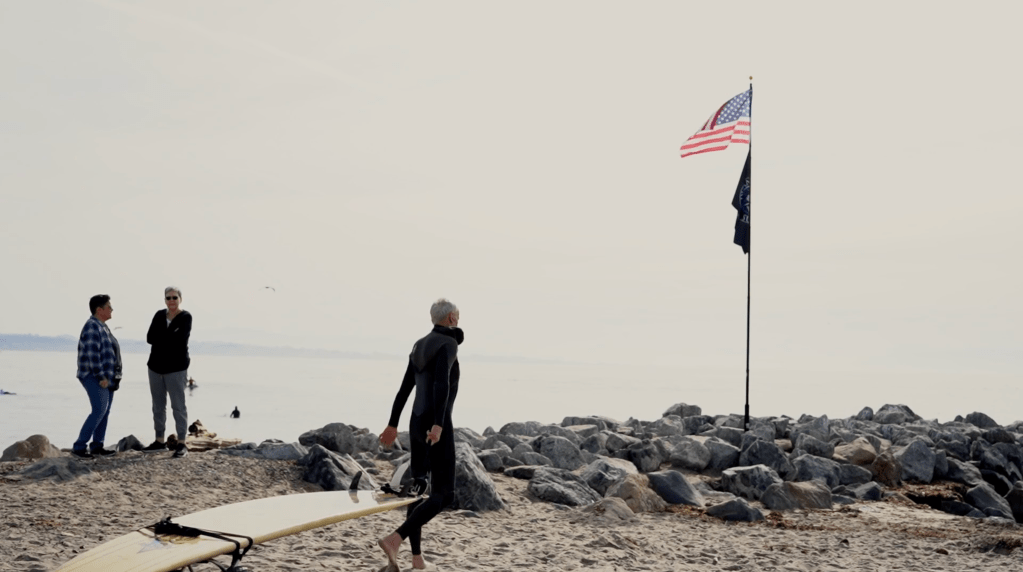
While the VSA hosts organization-wide surfs in Santa Cruz on the last Saturday of every month, individual chapters meet across the Northern California coast. The Gunrunner Surf Camp, a chapter which surfs exclusively at night at the Monterey Bay National Marine Sanctuary, meets multiple times a week. The Bay Area chapter continues to surf in Pacifica every Tuesday, rain or shine.
Meyer’s wife and three kids joined him on the beach for the Halloween event, as they do at many VSA events. Meyer doesn’t view “serving” as exclusive to only those of veteran status.
“My lady, she is… She is incredible,” he said of his wife. “Oh man, I wouldn’t be here if it wasn’t for her. Obviously she wasn’t downrange, she didn’t ever pull a trigger or anything like that, but she’s had to deal with the effects of it and the very dark, dark levels of it… She’s been through her own version, but she’s served just as well.”
In addition to Tiffany Meyer, who has played an integral role in VSA since its founding, lead surf coaches Brian Waters and Lance Lubarsky are not veterans themselves. Lubarsky said veterans are encouraged to bring their families.
“ Even me as a non-veteran, it’s very healing for me, losing my father to suicide because of PTSD,” Lubarsky said. “ It’s healing for me to know that I’m helping other people, and that there’s help for them. When my dad came out of Vietnam, there was no help, and now there is.”
Meyer’s vision for the future of the VSA involves opening a “clubhouse” near the Capitola shore, a homebase for storing surfing equipment and connecting veterans to resources: housing, employment, healthcare, benefits and more. It’s important for him to operate in his role in veteran outreach for the county somewhere near the waves. Like the VSA motto reads, Meyer is clear: “Surfing saved my life.”
“The ocean saved my life,” he continued. “Really, like, when I started this, I was at the bottom of it all. I was done. I was ready to wrap it up. And honestly, I don’t know that person anymore.”
Meyer finds it vital for the transitioning service member to discover an identity outside of the military.
“We get so tied to being a soldier, being a marine,” he said. “You have a hard time understanding things past that, and they don’t really train you for that either. So surfing, yeah, it’s very special. It’s a spiritual experience, really, for me. And sharing it with others.”
 ANASTASIA SOTIROPOULOS